Source: http://lasa.international.pitt.edu/LARR/prot/fulltext/vol42no2/Klesner.pdf
Argentina has been singled out as a region of particular political activism worldwide, and especially when compared with its neighbors in Latin America. This article cites the increased activity with a higher presence of civil society groups, a type of group that has been linked to increased political action. In this blog post, I will assess the findings of this article, and then compare it to my specific experience in Argentina and specifically Buenos Aires.
This study makes an effort to prove Robert Putnam’s assertion that a high level of social capital has a causal and correlative relationship with strong democratic participation. This study used the World Values Survey (1999-2001) to analyze the level of non-electoral political participation (including willingness to or ever having participated in political protests, strikes, occupation of building, and several other testers of political activism), focusing on Mexico, Argentina, Peru, and Chile. Ultimately, the study finds that higher political participation can be witnessed in demographics that participate in volunteerism based civil society groups, though a correlation does not result when viewing merely participatory social and recreational type groups, such as sports or work based networking.
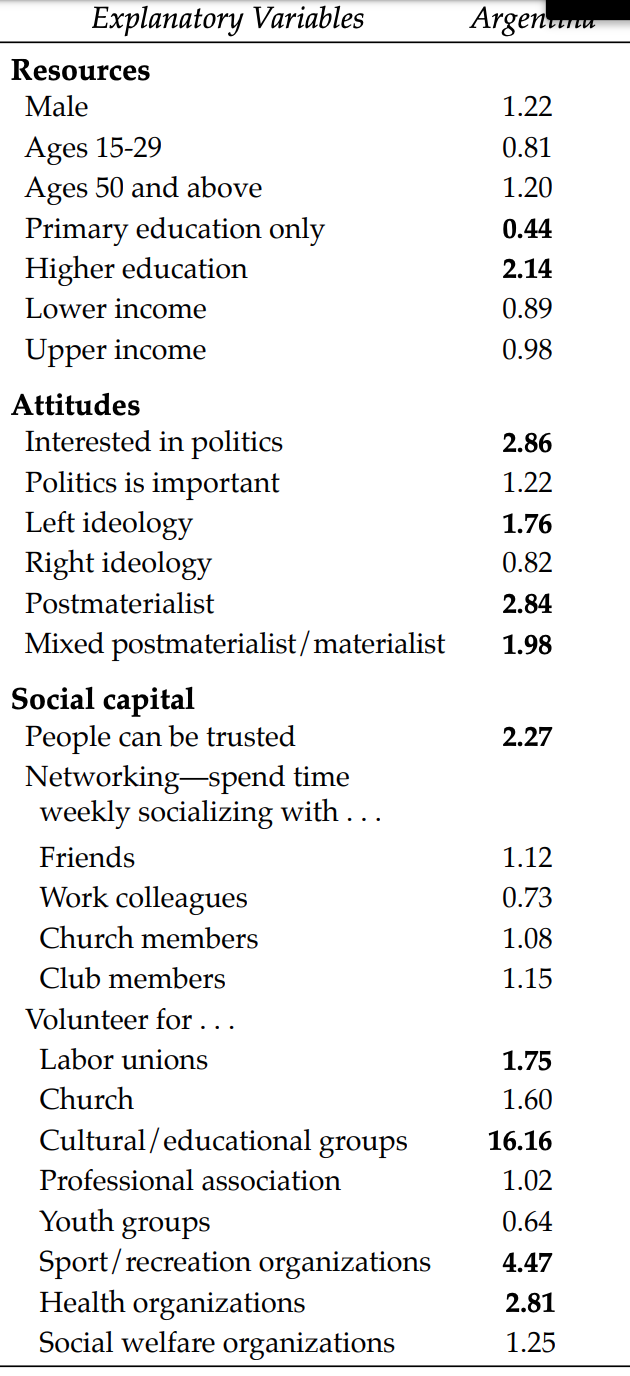
While the conclusions of the study are somewhat mixed, if an isolated examination is made of Argentina, the study soundly confirms Putnam’s theory. The table below lists a number of demographics and their respective scores based on levels of political participation. Some points of interest to me are a quadrupling of score from primary education to higher level education and relatively higher scores amongst labor unions, self-identified “post materialists”, members of cultural/educational groups, and sport/recreational organizations. Firstly, In my time in Buenos Aires, I have definitely noticed and heard about a significant presence of politically active university students. This confirms a well-established hypothesis that higher education leads to increased political involvement, as well as my own experience of growing more politically galvanized as I’ve attained higher levels of education. Next, Argentina is notorious for its extremely active and politically powerful labor unions, and my time here has only confirmed this. During our second week in the country, the CGT hosted a general strike to decry the economic policies of President Macri. The long history of labor unions in Argentina, and the anomaly of the absence of laws prohibiting their perpetuity, even if paused during non-democratic years, has cemented their power and relevance, particularly within the political-cultural movement of Peronism. Having such a long-standing and cemented historical precedent for the existence of and participation of labor unions in the political process has helped ensure significant access of organized labor in the political process, dating back to the gains made during the Peron era of the 1940’s. Thirdly, a portion of our class-time on this study abroad has been spent discussing the merits and results of the global adoption of post-materialist ideology, particularly amongst younger generations. Throughout the twentieth century, the dominant motivator throughout the western world was the accumulation of capital, as any good capitalist would, in the pursuit of ever heightened quality of life. However, in recent years the ultimate goal of capital accumulation has been decried within more progressive circles, in favor of the prioritization of non-material accomplishments, like fulfillment, equality, pursuit of passions, and artistic merit. Replacing the constant effort working to heighten a standard of living both frees up time to be politically active and the ideology tends to promote the ideals progressive political participation often fights for, certainly in Argentina. Finally, the political ramifications of participating in either a recreational/sport or a cultural/educational group are quite logical in a country like Argentina. Argentina both has a long history of political oppression, as well as an extremely powerful and locally organized system of sports-based participation in the form of socio and hooligan groups. A number of groups based on the raising of awareness regarding human rights abuses of the dictatorship of the 1970’s and 80’s would naturally have numerous political ramifications in society. Groups like the Abuelos de la Plaza de Mayo or the Madres de los Desaperecidos who serve the dual function of participating politically while raising awareness and ideally preventing repetitions of the political abuses of the dictatorship have had a clear effect on the political landscape of Argentina. Furthermore, sports-based groups are deeply organized and participatory actors in Buenos Aires, with over 50 football clubs, each with an extremely active and passionate groups of fans. The framework of these groups lends itself quite easily0 to the political process, as they share many similarities, like tightly knit bonds, accomplishment of shared goals, and clear means of communication. Someone who is an active participant in a group like these could easily form or participate in a politically participative group.

 Argentina Study Abroad