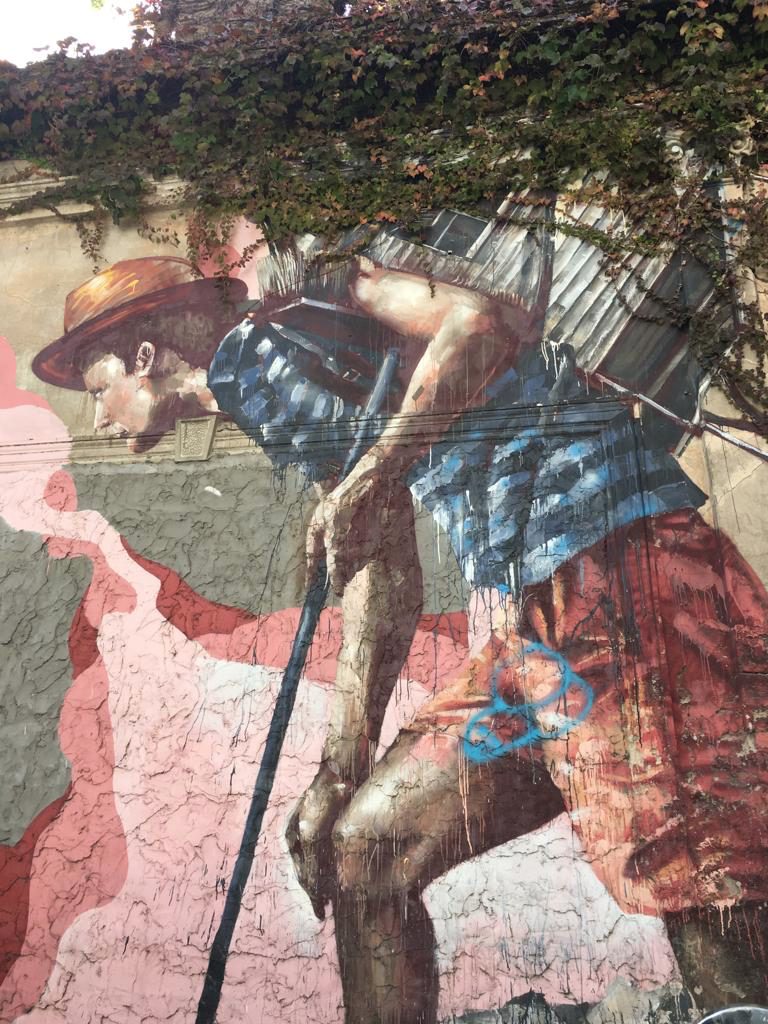
Our first week in Buenos Aires we went on a frankly disappointing street art tour. It was largely based on commercial aspects of street art and how it has been used as an advertising tool, rather than the politically active medium it was originally intended to be. However, this piece was one redeeming moment for the tour.
This piece is particularly exceptional because it actually conveys a message to the audience. The piece is painted on a house, tied up by inheritance issues, which the entrances had to be sealed off because of squatters staying illegally in the house.
The content of the piece means to evoke the gentrification crisis in Buenos Aires and world-wide. This piece can be found in Palermo SoHo, a formerly working class and bohemian neighborhood that, because of the fashion and touristic draw of such qualities, has now had the original artistic population driven out by increasing costs of living.
The man is meant to be one of these poor individuals pushed out by the gentrification crisis as he is carrying a traditional Australian home on his back. The location of Palermo SoHo combined with the Australian elements ties together the Australian artist’s personal experience with this issue with the global context of gentrification occurring in every artistic urban center on Earth right now.
This piece is particularly evocative because it is inherently temporal. The case of ownership of the house it is painted on will eventually be settled and the new owners will likely remove the mural. This again connects to the theme of true artistry being pushed out by commercial interests in areas of cultural depth and beauty.
Much emphasis has been put upon fostering artistic communities in urban centers, but the pitfalls are becoming more and more obvious. The more desirable Atlanta, Buenos Aires, Austin, or Toronto become because of their cultural wealth, the less authentic culture will actually be created. It is a difficult question because the beauty of most cities lie in their naturally developed culture and there is certainly a way to use this for economic development. Yet when the process is fully given over to market forces, there seems to be a clear fall off of the original artistic intent and population, defeating the original purpose of the development effort.

 Argentina Study Abroad